Planet Python
Follow
PyCharm: Best Object Detection Models for Machine Learning in 2026
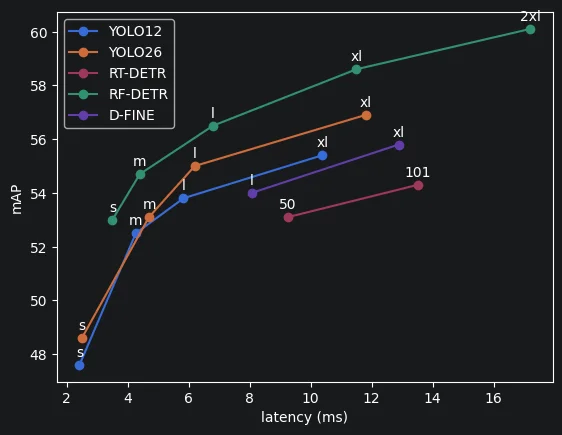
Object detection is a crucial computer vision task that identifies and locates multiple objects within images or video frames. This goes beyond simple image classification by pinpointing the exact position of each object with bounding boxes. Performance assessment requires metrics for both accuracy and computational efficiency, with Intersection over Union (IoU) and mean Average Precision (mAP) measuring detection quality. Frames per second (FPS) and parameter count are key indicators of a model's inference speed and resource requirements.Object detection architectures are broadly categorized as either CNN-based or Transformer-based, with modern models often fusing features from both. Processing flows are also divided into two-stage detectors, which perform region proposals then classification, and single-stage detectors that predict directly in one pass. While historically two-stage models offered higher accuracy, single-stage detectors have largely closed this gap and are generally faster.In 2026, two-stage pipelines are considered less competitive, with the leading models being single-stage, NMS-free Transformer architectures and YOLO family variants. RF-DETR stands out as the strongest real-time model, achieving the highest mAP on complex scenes due to its use of DINOv2 and deformable cross-attention. It excels in domain adaptability and supports both detection and segmentation, though it is heavier than YOLO on edge devices. YOLO12 represents an attention-centric approach, integrating self-attention mechanisms with CNNs for balanced performance. It offers competitive inference speeds and benefits from global context understanding. It is important to use the original implementation of YOLO12 for optimal performance, as some ports have been noted for inefficiencies.