DEV Community
Follow
Python Lists : Common way to store data
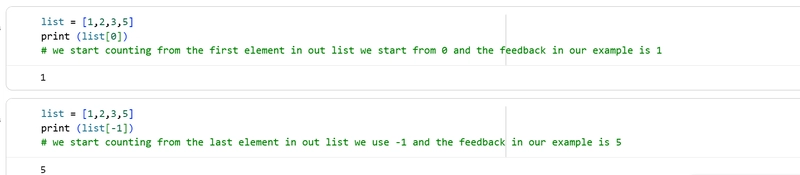
Python offers four built-in data structures: sets, dictionaries, tuples, and lists. Lists are characterized by being stored in square brackets, maintaining order, being mutable, and allowing duplicate values. Data within lists can be accessed using indexing, starting from 0 for the first element or -1 for the last. Slicing extracts portions of a list by specifying start and stop indices, with the stop index excluded. Unpacking allows assigning list items to variables, using an underscore for unassigned elements. Python provides functions like len(), max(), min(), and sum() to analyze list contents. Specific items can be searched for and their counts determined using the .count() and .index() methods. Membership and identity are checked with 'in' and 'is' operators, respectively. The all() and any() functions assess the truthiness of list elements. Lists can be modified by appending or inserting elements, clearing all items, or removing specific values or by index using pop(). Updating elements is done by assigning a new value to a specific index. Lists can be ordered in place using the .sort() method, either ascending or descending. Alternatively, the sorted() function creates a new sorted list without altering the original. The .reverse() method reverses the original list, while the reversed() function creates a new reversed copy.