Google Cloud Blog
Follow
Report: 83% of organizations need to upgrade their infrastructure to support agentic AI
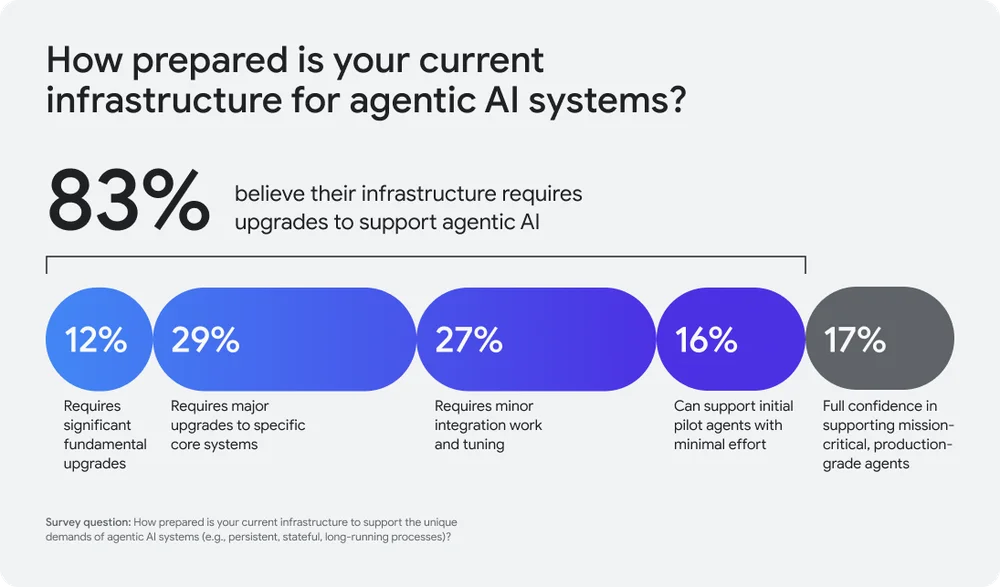
The enterprise AI landscape has evolved from conversational bots to agentic AI that takes independent action. This shift strains existing infrastructure, with 83% of organizations needing upgrades for production-grade agentic AI. Legacy architectures struggle with the scale and continuous reasoning of autonomous agents, leading to an "inference tax" of data egress, storage bloat, and idle hardware. Fluid compute, matching silicon to tasks and minimizing overhead, is crucial for addressing these inefficiencies. Centralized governance is essential to manage the proliferation of autonomous agents and address security, governance, and MLOps challenges. A unified data layer allows agents to access and understand information regardless of its location, eliminating fragmentation. Hybrid multicloud architectures are becoming the norm, driven by digital sovereignty and the need to comply with local data residency laws. Edge AI deployment is critical for reducing latency, ensuring operational resilience, and improving cost-efficiency by processing interactions closer to the source. Energy consumption is a significant operational factor, influencing hardware selection due to grid scarcity, regulatory compliance, and infrastructure economics. Adopting unified, AI-optimized infrastructure, like Google Cloud's AI Hypercomputer, where all layers are co-designed, is key to overcoming these challenges. This holistic approach enables physical AI, where autonomous systems can interact with and solve real-world problems.