Security Boulevard Note

Security Boulevard

Security Boulevard is a digital platform focused on covering news and insights related to cybersecurity and information security. The site provides articles, interviews, and opinions from various influencers, thought leaders, and experts in the security industry. The content range includes topics such as malware, ransomware, phishing, compliance regulations, encryption, and more, offering insights into latest trends and emerging threats in the cybersecurity community. Further, the site has blog sections, news, and featured articles that cater to security practitioners, researchers, and interested readers. It claims to aim at providing educational, and informative content by bringing diverse perspectives on cybersecurity topics.

Thread Of Notes

The Half of Agent Security You’re Not Governing

The governance of AI agents faces a fundamental asymmetry: while MCP servers provide structured logs, the "Skills" that drive agent reasoning remain forensic black holes. As high-risk capabilities—such as arbitrary code execution and state changes—become prevalent in nearly 60% of enterprise deployments, traditional models like the "Rule of Two" are failing to prevent autonomous destruction. To counter this, Noma Security proposes the No Excessive CAP framework, focusing on the three controllable levers of defense: Capabilities, Autonomy, and Permissions.
CdXz5zHNQW_i5ki6sAVhk.webp

ShinyHunters Claims Responsibility for Breach of EdTech Company Instructure

The prolific extortion group ShinyHunters claimed responsibility for the breach of Edtech vendor Instructure's systems, stealing 3.65 TB of sensitive information, including names, email addresses, and messages of students, teachers, and others. ShinyHunters also reportedly behind an early attack of Instructure in September 2025.
CdXz5zHNQW_IGdeK0YfnT.webp

CAF Objectives Overview for UK SMEs: A Practical Guide to the NCSC Cyber Assessment Framework

CAF Objectives Overview for UK SMEs: A Practical Guide to the NCSC Cyber Assessment Framework If you are a UK SME, the NCSC Cyber Assessment Framework, usually shortened to CAF, can look more formal than it needs to be. In practice, it is a structured way to think about whether your cyber security is good […]

EasyDMARC and KnowBe4 Partner to Advance Proactive Email Security as Phishing Fuels More Than One-Third of Cyberattacks

Originally published at EasyDMARC and KnowBe4 Partner to Advance Proactive Email Security as Phishing Fuels More Than One-Third of Cyberattacks by Anush Yolyan. Dover, Delaware and Tampa Bay, Florida | May ...

Identity Risk Intelligence vs Threat Intelligence: What’s the Difference?

Introduction: Two terms, one growing confusion In cybersecurity conversations today, two terms are showing up more frequently: Threat Intelligence Identity Risk Intelligence At a glance, they sound similar. Both deal with data, risk, and security insights. But they solve fundamentally different problems. And understanding that difference is becoming critical because, as attackers shift toward identity-based […]

Fake Party Invites and the Rise of Social Phishing Attacks

Attackers are now impersonating invitation services to trick people into clicking malicious links and sharing sensitive information. These phishing attempts look like legitimate event invites, making them especially effective. In this episode, we discuss how these scams work and what steps you can take to stay protected. Special thanks to Guardsquare for sponsoring this episode! […]

Securing AI procurement and third-party models: a practical guide for UK SMEs

Securing AI procurement and third-party models: a practical guide for UK SMEs Third-party AI tools can be useful, but they also change the way your business handles data, makes decisions, and depends on suppliers. For many UK SMEs, the risk is not the model itself. It is the way the tool is bought, connected, configured, […]

CISO Diaries: Victor-Andrei Nicolae on Practical Security, Patience, and AI-Driven Defense

Security leadership is often associated with emerging threats and advanced technologies, but much of the role comes down to disciplined execution, thoughtful decision-making, and balancing protection with business continuity. In CISO Diaries, we speak with leading CISOs around the world to understand what the role actually looks like beyond frameworks and incident headlines, how security […]

1,800 Developers Hit in Mini Shai-Hulud Supply Chain Attack Across PyPI, NPM, and PHP

What happened A supply chain attack campaign attributed to TeamPCP, dubbed Mini Shai-Hulud, has compromised packages across the PyPI, NPM, and PHP ecosystems over a two-day period, affecting over 1,800 developer repositories containing stolen credentials. The campaign was first identified on April 29 when malicious versions of four SAP NPM packages were caught delivering information-stealing […]

ConsentFix v3 Automates OAuth Abuse to Bypass MFA and Hijack Azure Accounts

What happened A third iteration of the ConsentFix attack technique has been circulating on hacker forums, introducing automation and scalability to a method that abuses Microsoft Azure’s OAuth2 authorization code flow to hijack accounts without passwords and despite multi-factor authentication being enabled. The original ConsentFix was documented by Push Security in December 2025 as an […]

FBI Links Cybercriminals to Sharp Surge in Cargo Theft Attacks

What happened The FBI issued a public service announcement on April 30, 2026, warning the US transportation and logistics industry of a sharp rise in cyber-enabled cargo theft, with estimated losses in the United States and Canada reaching nearly $725 million in 2025. That represents a 60% increase over the prior year. Confirmed cargo theft […]

Edtech Firm Instructure Discloses Cyber Incident, Probes Impact

What happened Instructure, the company behind the Canvas learning management system, has disclosed that it recently suffered a cybersecurity incident perpetrated by a criminal threat actor and is now investigating its scope with the help of outside forensics experts. The disclosure was made by Chief Security Officer Steve Proud, who committed to transparency as the […]

Congress Punts FISA Section 702 Renewal to June

What happened Congress approved a 45-day extension of Section 702 of the Foreign Intelligence Surveillance Act on Thursday, hours before the program was set to lapse, pushing the next deadline to June 12. President Trump is expected to sign the legislation before the midnight deadline. The path to the extension was complicated. The day prior, […]

Ameriprise Financial Data Breach Exposes Personal Information of 48,000 Customers

What happened Ameriprise Financial has disclosed a data breach affecting nearly 48,000 individuals across the United States, following unauthorized access to stored company data and files that began on March 2, 2026. The company detected the intrusion on March 18, approximately 16 days after it began, and filed a breach notification with the Maine attorney […]

I Mapped Every Major Startup Credit Program for 2026. Most Founders Are Leaving $500K+ on the Table

Founders raise venture money to extend runway. Then they leave six figures of free credits sitting in a portal they never logged into. After watching this happen for a decade, I built a public directory of every major program. Here's what I learned mapping the landscape.

[un]prompted 2026 – Source to Sink: Improving LLM Vuln Discovery

Author, Creator & Presenter: Scott Behrens, Principal Security Engineer At Netflix & Justice Cassel, Application & GenAI Security At Netflix, Our thanks to [un]prompted for publishing their Creators, Authors and Presenter’s outstanding [un]prompted 2026 AI Security Practitioner content on the Organizations' YouTube Channel.

Web application testing with Burp Suite: a practical guide for UK SMEs

Web application testing with Burp Suite: a practical guide for UK SMEs For many UK SMEs, web applications are now part of day-to-day business. They handle customer logins, staff portals, booking systems, supplier access, and internal admin tasks. That makes them valuable, but it also means they deserve regular security attention. Burp Suite is a […]

RBI Cybersecurity Compliance Checklist for Fintech Organizations

The financial services ecosystem in India is undergoing rapid digital transformation, and fintech organizations sit at the center of this evolution. With increasing cyber threats targeting digital payments, lending platforms, and financial data, regulatory oversight has intensified. The Reserve Bank of India mandates a strong RBI cybersecurity framework that fintechs must follow to ensure resilience, […]

North Korea’s Enormous Crypto Hacks Redefine Scale and Strategy

A pair of tightly executed cyberattacks have become milestones in cryptocurrency theft in 2026 due to their sheer size. These two incidents, targeting Drift Protocol and KelpDAO, account for roughly three quarters of all recorded crypto losses through April, revealing a shift toward fewer, higher-dollar operations. Based on a report from TRM Labs, security researchers..
CdXz5zHNQW_E0IFFTak2g.jpeg

Global Cyber Threat Brief: Identity Breaches, Supply Chain Attacks, and the Rise of Organized Cybercrime

In the past week, the global cyber threat landscape has once again demonstrated how rapidly attackers are evolving shifting from isolated intrusions to coordinated, multi-stage campaigns targeting identities, supply chains, and service providers. From large-scale identity data exposure to sophisticated token abuse and ransomware-driven disruptions, these incidents highlight a critical reality: attackers are increasingly exploiting

Addressing the Edge Security Paradox

The paradox of edge security describes how technologies designed to strengthen network defenses can also create new vulnerabilities. Edge devices improve performance and support localized threat detection by processing data closer to its source, yet modern enterprise environments often operate thousands of distributed endpoints. This rapid expansion of edge infrastructure increases the number of systems..
CdXz5zHNQW_p41Fa4SguK.png

Invisible Threats Within: Detecting Botnet Activity and Data Exfiltration Before It’s Too Late

In today’s cyber threat landscape, attacks are no longer always loud or immediate. Many of the most damaging incidents begin quietly hidden within normal network activity, disguised as legitimate traffic, and evolving over time into full-scale compromises. Modern security requires more than just detection; it requires context, behavioral intelligence, and early intervention. This article highlights

Building Entity Authority in Cybersecurity: The Trust Signals AI Models Actually Weight for Security Vendors

AI models weight trust signals differently in cybersecurity. A comprehensive framework for building entity authority as a security vendor, covering third-party corroboration, author entities, community presence, research credibility, & authority flywheel that compounds citation share.

Time to Rethink Privileged Access for Machines and AI Agents

For years, Identity and Access Management (IAM) and Privileged Access Management (PAM) have been treated as foundational and a solved security challenge. Organizations deployed vaults, enforced policies, and checked the compliance box for their privileged users.  Fast forward to today, and that model no longer holds up.    What’s emerging now is not an incremental shift, but a structural one. Identity is no longer centered on […]

The Agentic AI Security Category Is Converging on the Wrong Answer

In Part 1 of this piece, I described what agentic AI attacks actually look like in practice; the digital factory model, where agents commit fraud, and the three properties that make agentic AI attackers categorically different from traditional bot tooling: autonomous iteration, session-to-session learning, and identity spoofing at the interaction layer. Now I want to … Continued

U.S. Consumers Lost $2.1 Billion in Social Media Scams in 2025, FTC Says

An FTC report says that Americans last year lost $2.1 billion in social media scams, such as shopping and investment schemes. Social media site have become the place where most of these scams start, and more than half of that money was stolen in scams began on Facebook, WhatsApp, and Instagram.
CdXz5zHNQW_88dV4eEGXY.jpeg

A Guide to Agentic Sprawl: How to Govern Your Program

Key Takeaways Agent user identities now outnumber human identities at an astounding rate. Each new autonomous agent introduces a new identity, a new credential path, and a new surface area for attackers to exploit. Agent sprawl compounds classic identity security failures: over-provisioned OAuth scopes, reused service accounts, and long-lived tokens. Traditional IAM tooling was never...

How AutoSecT Uses AI to Find Vulnerabilities That Actually Matter

We always think we are more vulnerable than our fellow contemporaries! In general sense, this shows lack of confidence, but when you are dealing with security, this is one of the best traits you can have! Sounds strange, right! Let’s be honest, most security teams aren’t short on vulnerability data. They’re drowning in it. Scan […]

NIST Cybersecurity Framework for UK SMEs: A Practical Guide to Identify, Protect, Detect, Respond, and Recover

NIST Cybersecurity Framework for UK SMEs: A Practical Guide to Identify, Protect, Detect, Respond, and Recover The NIST Cybersecurity Framework is a useful way to organise cybersecurity work around business risk. For UK SMEs, that matters because most teams do not have the time or budget to do everything at once. A framework gives you […]

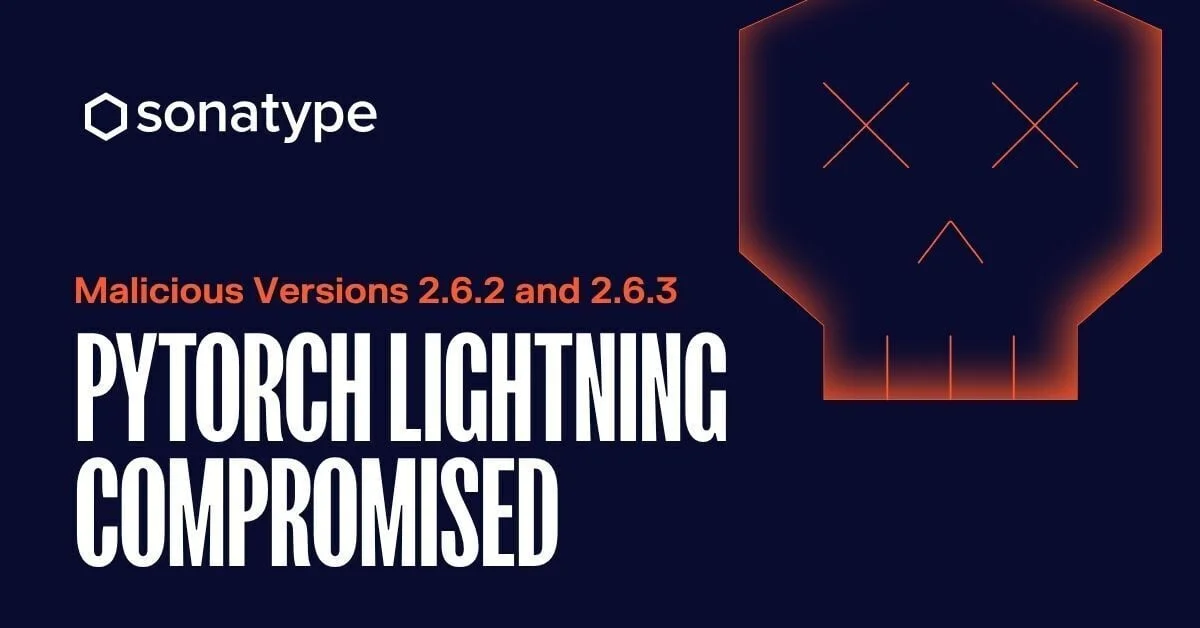
Malicious PyTorch Lightning Packages Found on PyPI

Malicious versions 2.6.2 and 2.6.3 of the PyTorch Lightning package were uploaded to PyPI, after the publisher's account was compromised. These packages, published on April 30, 2026, contained malicious code designed to steal developer credentials. Importing the package activates a background process that executes a large, obfuscated JavaScript payload. This payload targets multi-cloud services like AWS, Azure, and Google Cloud, along with GitHub APIs. The malware also downloads a secondary payload from attacker-controlled infrastructure. The attack is particularly dangerous because it used a compromised version of a trusted package. Attackers quickly released version 2.6.3 to evade detection after version 2.6.2 was flagged. Small changes, like metadata updates, were used to avoid triggering security measures. Users who installed these versions should treat their systems as compromised and remove the malicious packages. Best practices include pinning dependencies, monitoring for anomalies, and using automated supply chain security tools. Security teams need to move towards context-aware, behavior-driven analysis to stay ahead of these threats.
CdXz5zHNQW_EZ0jZr7aIg.jpeg