Google Cloud Blog
Follow
Scaling Telco Autonomy: Leveraging GNNs with Distributed GraphFlow
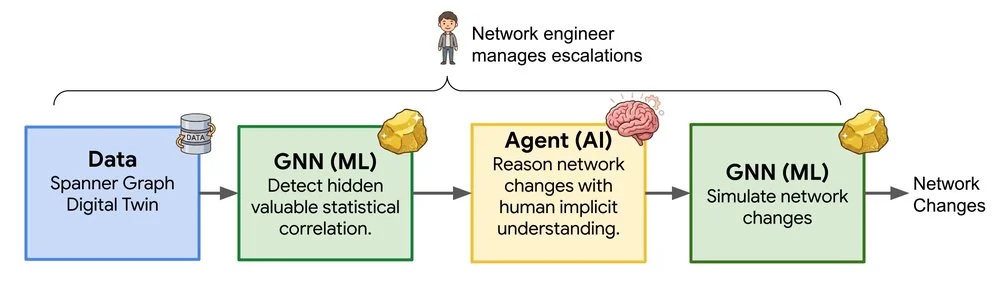
The telecommunications industry is transitioning to autonomous network operations, driven by the increasing complexity of modern networks. Traditional manual methods and basic machine learning are insufficient for automating these sophisticated systems. AI agents offer reasoning capabilities but struggle with the massive scale of network data. To bridge this gap, Graph Neural Networks (GNNs) are being integrated with AI agents to process large-scale temporal and relational data. This combination allows for advanced diagnostics like root cause analysis and capacity planning, along with reasoning and action execution. Google Cloud's Autonomous Network Operations framework uses a three-component approach: Data, ML, and AI. The foundation is a network digital twin, a dynamic graph representation of the live network, hosted on Google Cloud's Spanner Graph for scalability and multi-model support. The ML layer utilizes Distributed Graph Flow (DGF), an open-source Python library for managing GNN lifecycles, enabling predictive insights. DGF simplifies GNN model development, allowing for applications like anomaly detection, root cause analysis, and predictive maintenance. It also facilitates "what-if" analyses by simulating network changes and their impacts. A five-step process outlines implementing root cause analysis using DGF and GNNs, involving connecting to the digital twin, training a prediction model, and deploying it for real-time inference. This GNN-powered evolution promises shorter outage times, optimized capacity, and improved customer experience.