Google Cloud Blog
Follow
Semantic aggregation over millions of rows in BigQuery with AI.AGG
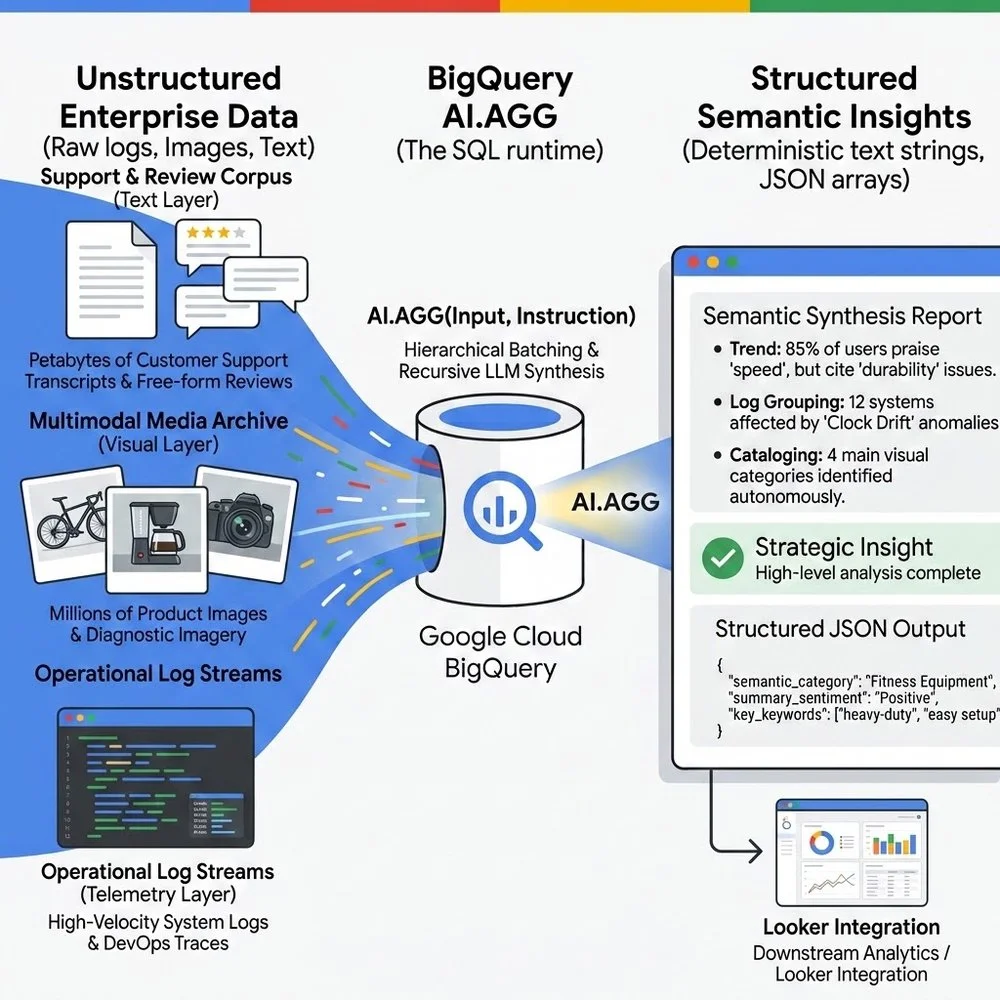
BigQuery's new AI.AGG feature, currently in preview, revolutionizes unstructured data analysis by enabling multi-level semantic aggregation directly within GoogleSQL. This addresses the critical gap where traditional relational SQL engines struggled with synthesizing insights from massive text and multimodal datasets due to large language model (LLM) context window limitations. AI.AGG conceptualizes semantic aggregation as a distributed map-reduce problem, allowing data teams to run natural-language instructions over millions of rows with a single SQL query. The underlying multi-level batching architecture automatically handles row validation, context-safe batching, parallel inference via Vertex AI, and recursive synthesis using full-weight LLMs until a single, aggregated string is produced. It natively supports both text and multimodal inputs, leveraging BigQuery Object Tables for image analysis without data movement. AI.AGG is designed for transformative enterprise use cases, such as diagnostic analysis of high-volume system logs and building "agentic data clouds" for autonomous data labeling pipelines. Prompt engineering for AI.AGG requires explicit output contracts, contextual delimiters, failure state design, and few-shot anchoring to ensure programmatic SQL outputs. Cost management involves pre-filtering with WHERE and LIMIT clauses and utilizing Gemini Context Caching, with AI.COUNT_TOKENS for estimation. The feature operates within BigQuery's governance framework, supporting VPC Service Controls and gracefully degrading on transient errors. Preview guardrails include a 10,000-token output cap per group, 10 MiB row limit, and recommendations for processing up to 20 million rows and 1,000 distinct SQL groups. AI.AGG transforms the enterprise data warehouse into an active, semantic runtime, democratizing access to petabyte-scale semantic analysis.