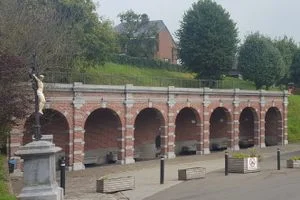
Six Fontaines in Herve, Belgium
In Herve, Belgium, a brick building constructed in 1894 houses the town's primary water source, featuring seven arches. This structure replaced an earlier washhouse from 1783 that had only two wells. Increased population and industrial relocation led to water usage conflicts, necessitating a division of the water supply. The solution involved seven wells, with six feeding into large limestone basins collectively known as the Six Fontaines or Six Batches. Each of these six basins served a specific purpose. These functions included watering animals, washing pigs, a large tub for washerwomen, a central well for filling buckets, a small tub for washing sausage casings, and a tub for general domestic use. The final well, the Batch Lecomte, was named after a family who exclusively drank its water, believing it to be the finest. Despite common belief, all wells draw from the same source and possess identical water characteristics. A local legend claims that on Christmas Eve, wine flows from the Lecomte fountain, but drinking it is fatal.