Google Cloud Blog
Follow
Solving the "Noisy Neighbor": How Sharded Architecture Protects Multi-Tenant Platforms
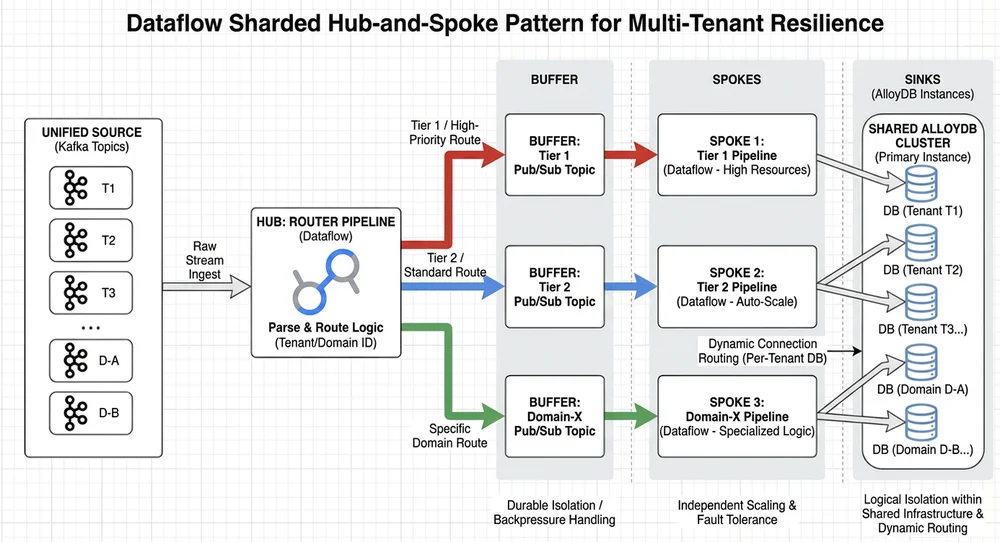
Shared infrastructure environments, like those used by SaaS providers and enterprises, are vulnerable to the "noisy neighbor" problem. A single tenant's intense data activity or a failing database can degrade performance for all users, leading to backlogs and SLA violations. Legacy monolithic architectures, where all data flows through a single stream, exacerbate this issue. This means one database failure can halt all processing, requiring inefficient scaling for worst-case scenarios. Maintaining stable SLAs becomes nearly impossible when one tenant's high volume impacts the entire system.The solution is a sharded hub-and-spoke architecture, which decouples processing into a central hub for routing and isolated spokes for execution. The hub, a lightweight Dataflow job, acts as a traffic controller, parsing tenant IDs and fanning data into isolated buffers. These buffers, implemented as durable Pub/Sub topics, prevent slow downstream sinks from impacting the original source. The spokes consist of multiple smaller Dataflow instances, categorized by workload like high-priority, shared tiers, or domain-specific pipelines. This isolation significantly reduces the blast radius of failures from 100% to under 5%. It also allows for independent scaling based on tenant load, unlike the inefficient worst-case scaling of monolithic systems. Maintenance becomes safer, as updates to one domain do not necessarily affect others. Additional optimizations like Dead Letter Queues, strict connection pooling, and asynchronous I/O further enhance stability and prevent pipeline stalls. By adopting this sharded approach, platforms can eliminate the noisy neighbor threat, ensuring strict SLAs and enabling safer deployments.