Google Cloud Blog
Follow
Staying Ahead of Adversarial AI Through Agentic Source Code Review
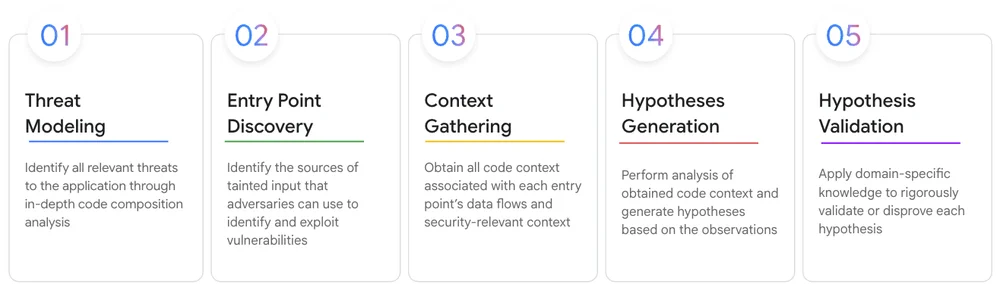
The increasing risk of data theft and extortion due to AI-driven code analysis necessitates a structured approach to defense. The Agentic Vulnerability Discovery Harness (AVDH) enhances vulnerability discovery by combining AI models with human expertise in an orchestrated pipeline. This framework accelerates the identification and validation of vulnerabilities during proactive reviews, penetration tests, and incident response. AVDH has demonstrated real-world success, discovering over 100 critical vulnerabilities in two days during a recent incident response. It has analyzed millions of lines of code, generating tens of thousands of findings and leading to numerous CVE disclosures. The AVDH architecture utilizes harnesses, which mitigate AI unpredictability and improve code analysis effectiveness. It is built using Google's Agent Development Kit (ADK) and integrates with Google Antigravity for managing agentic workflows. The pipeline follows a structured, sequential approach, similar to waterfall development, beginning with threat modeling. An Explorer agent identifies the codebase's purpose, followed by Specialist Explorers delving into specific areas. A Threat Model Synthesis agent aggregates findings, which are then presented to a human consultant for verification. Entry point discovery agents, using Gemini Flash Lite, identify application entry points and associated user input sources. Enrichment agents aggregate relevant code for isolated entry points to enable deeper analysis. Hypothesis generation agents focus on control and data flow, with a confidence filter managing the volume of hypotheses. Validation agents, configured with high temperature settings, assess these hypotheses, and a Synthesis agent makes a final determination. Confirmed findings are then subjected to rigorous human expert review, including dynamic exploitation and proof-of-concept execution. Any findings not passing human validation are discarded.