UX Collective | Medium
Follow
The AI experience doesn’t care about your org chart
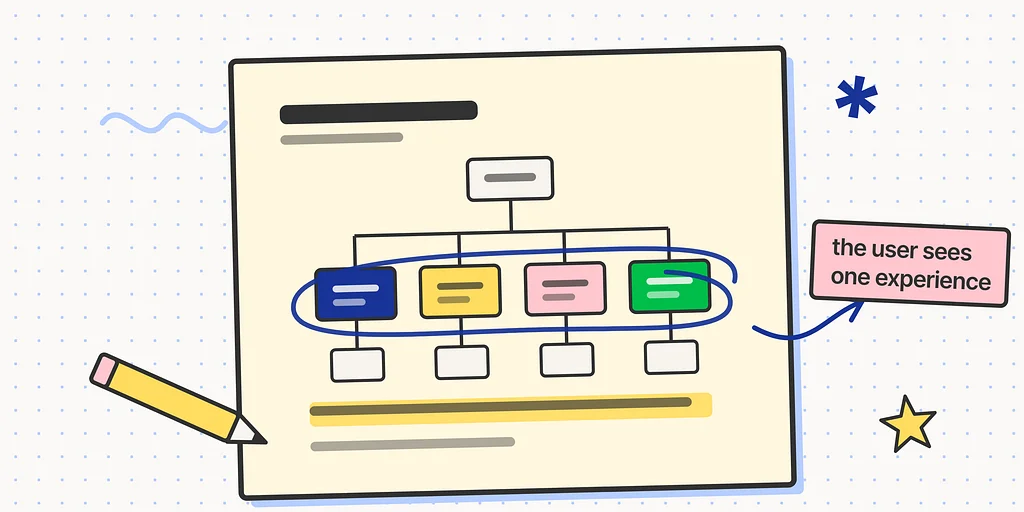
AI is merging previously separate content domains like design, strategy, and knowledge management into a single user experience. This integration reveals that current work practices are not adequately prepared for the interdependence of these systems. A finance manager's struggle to understand invoice payment status due to AI's incomplete understanding of business processes exemplifies this broken user experience. This challenge arises because enterprises are combining content and knowledge ecosystems managed historically in isolation.Navigating this is complex as we discuss AI and content transformations, not just one. Sarah Gibbons identified four types of "AI design," each with different implications for content work. Designing with AI speeds up existing processes, while designing for AI agents requires systems that represent concepts and actions reliably for machines. The fourth type, designing the AI itself, encompasses model behavior and shapes all other AI design areas.Specialization within content design is increasing, moving towards structured content systems and model behavior design. However, there's a growing need for expertise in semantic and context architecture, utilizing taxonomies, ontologies, and knowledge graphs to establish shared meaning across systems. This requires content designers to collaborate with technical teams and actively shape the semantic architecture of experiences.The challenge intensifies when considering UX content design in relation to other enterprise content domains. AI systems now draw on documentation, marketing content, and knowledge bases governed by various functions. This real-time assembly of experiences from diverse sources creates new operational complexities, as no single team may possess the full visibility to diagnose and fix issues.To address this, coordinated decision-making must be scaled across teams responsible for enterprise knowledge, semantic architecture, and AI engineering. While reusable systems have helped scale content design historically, AI makes inconsistencies more impactful. Scaling content design means making good design decisions repeatable, and these decisions now span multiple teams' tools and processes. An enterprise-wide change in terminology, for instance, now requires updating not just UI strings and help content, but also taxonomies, AI retrieval mechanisms, and agent interpretations.