ZeroHedge News
Follow
The Great Normalization (Nobody Declared Martial Law... Yet America Began Looking Like It Anyway)
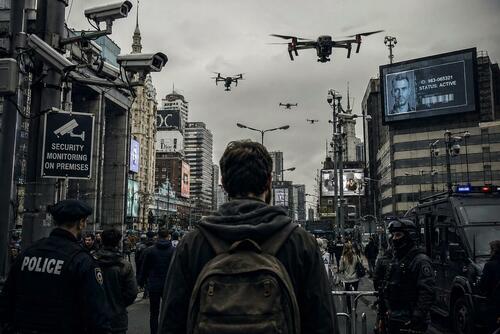
Madge Waggy's investigation reveals a subtle societal transformation driven by the gradual integration of surveillance and security technologies. This shift, often unnoticed in real-time, has fundamentally altered everyday life. What were once extraordinary security measures have become commonplace, appearing one camera, drone, or security contract at a time. This quiet militarization is administrative and commercial, arising from private company contracts, insurance requirements, and municipal investments. Human adaptation to these changes is rapid; familiar technologies and practices, like cameras and security guards, quickly become normalized background elements. A retired emergency management coordinator observed that individuals once exclusively associated with carrying radios and wearing body armor, like police officers, are now outnumbered by private security personnel similarly equipped. This phenomenon extends beyond government control, with private entities like corporations and homeowners contributing to a distributed surveillance ecosystem. Despite the pervasive observation, daily life continues normally, leading many to view surveillance as a mere technological convenience. However, history shows that infrastructure built for one purpose often acquires new functions, and surveillance technologies are following a similar path, extending beyond crime prevention. The author emphasizes that these changes are not dramatic leaps but the cumulative effect of thousands of seemingly reasonable, independent decisions. This gradual accumulation has made surveillance an invisible yet integral part of modern existence.