DEV Community
Follow
The Origin Series : The Birth of Docker
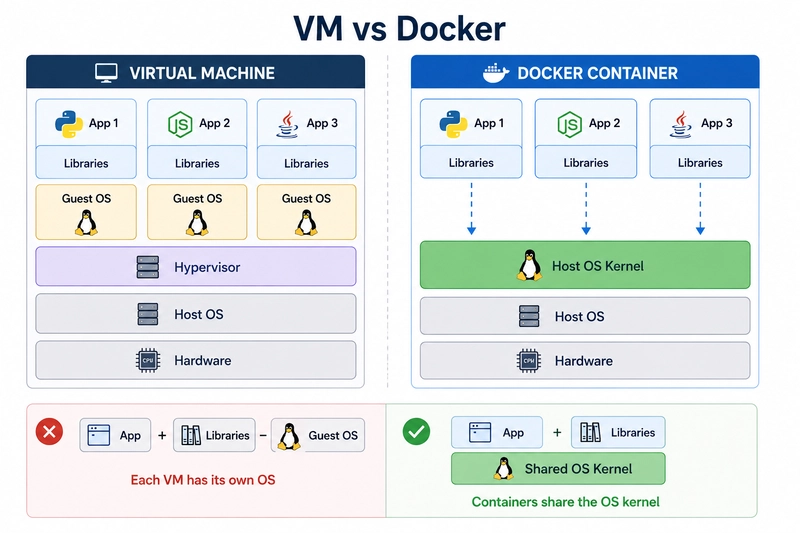
The software industry grappled with deployment issues for years, as applications worked on developer machines but failed in production due to environmental differences. Initially, companies relied on physical servers, dedicating one machine per application to avoid conflicts, leading to inefficient hardware utilization. Virtualization emerged as the first major breakthrough, allowing a single physical server to host multiple independent virtual machines, each with its own operating system, significantly reducing hardware costs and improving efficiency. However, virtual machines were resource-intensive due to the duplication of entire operating systems, prompting a search for lighter isolation methods. This led to the development of containers, which package applications with their libraries but share the host OS kernel, making them much more lightweight and efficient. Linux had existing container technologies like chroot, namespaces, and cgroups, but they were complex for developers to use directly. Docker revolutionized the industry by providing a user-friendly interface for these existing container technologies. The company dotCloud initially developed container tools as part of its Platform-as-a-Service offering. Developers showed more interest in the container technology itself than the platform. dotCloud open-sourced this technology, which became known as Docker in 2013. Docker simplified the use of containers by abstracting away the underlying Linux complexity. This made containers accessible to millions of developers through simple commands, transforming them from an expert feature into a mainstream tool.