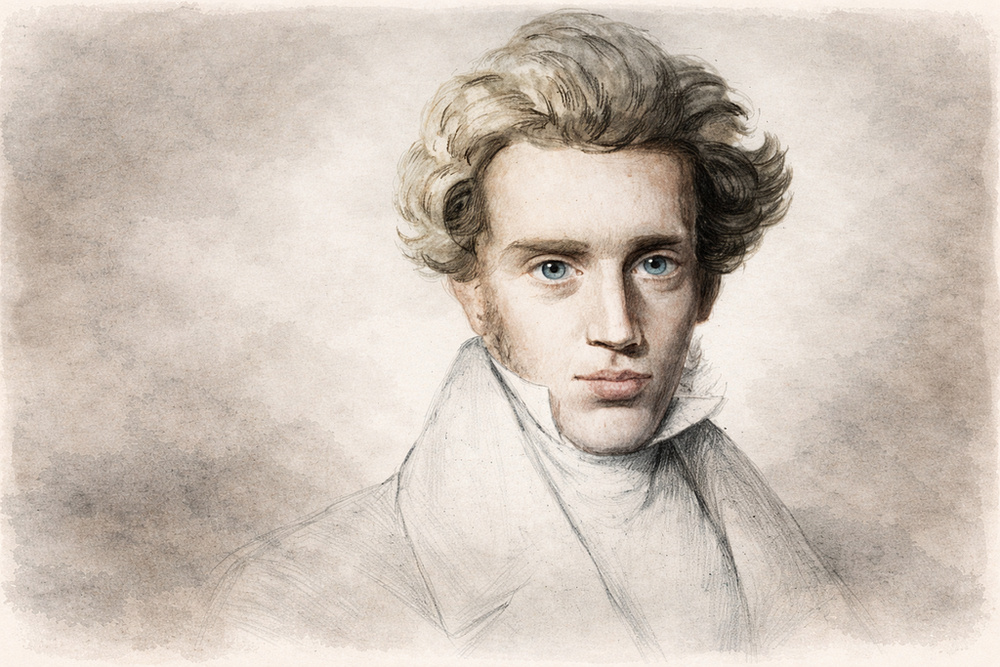
Kierkegaard believed that when certainty becomes mandatory, it is often a sign that something is not true. In his time, Christianity was the background noise of Copenhagen, and people inherited their faith without questioning it. Kierkegaard noticed that people spoke confidently about their beliefs, but this confidence felt rehearsed, and they didn't seem to wrestle with their convictions. As he grew older, he saw how certainty had replaced belief, and people learned to perform conviction rather than develop it. This created a shallow harmony, where collective certainty never had to prove itself against anything real. Kierkegaard's concern was not disbelief, but unearned belief, where conviction is without scrutiny and identity is without introspection. He believed that the desire for certainty often poses as a strength, but usually signals the opposite - a lack of faith. In Kierkegaard's view, faith was not a conclusion, but an ongoing willingness to live with what can't be guaranteed, and certainty makes a different promise, offering closure and letting people stop examining what they believe. Institutions depend on predictability, and certainty delivers, keeping people aligned and roles stable, but this creates a loop that's hard to break, where people adopt certainty because it makes them feel secure, and institutions reinforce certainty because it makes people easier to manage. Ultimately, Kierkegaard saw that unearned certainty has consequences, and as it takes over, faith has nothing left to do, and people learn to avoid questions, and the work of examining what they believe starts to fade.

uxdesign.cc
uxdesign.cc

RSS Hunter
2026-01-03