Google Cloud Blog
Follow
Unify operational and Lakehouse data with direct Iceberg access in AlloyDB for PostgreSQL
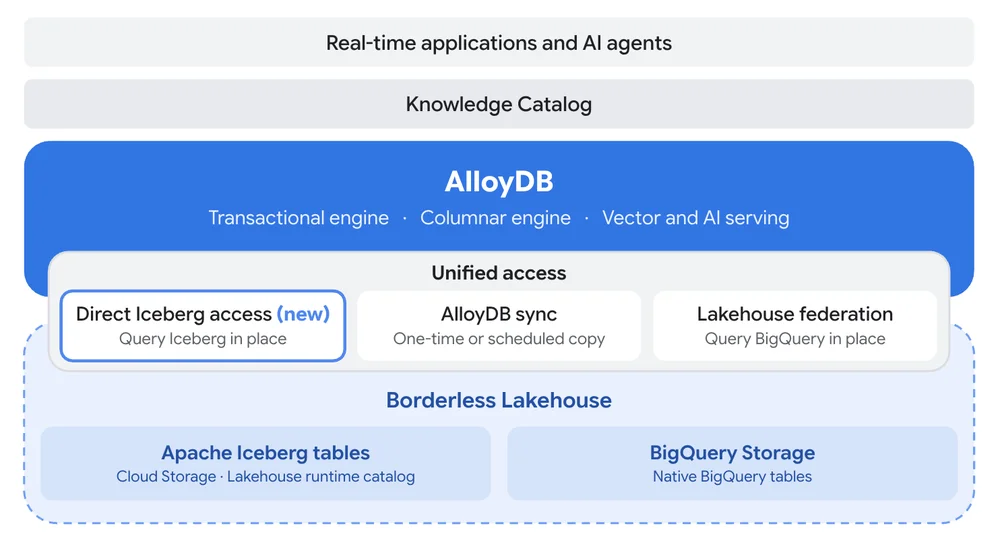
Businesses need both real-time operational data and historical analytical data for effective decision-making. Traditionally separate, these data systems are now converging, exemplified by new features in AlloyDB for PostgreSQL. Google Cloud is introducing direct Iceberg access, allowing developers to query Apache Iceberg tables in cloud storage directly from AlloyDB, joining them with live data in a single SQL query. This integration, now in preview, is significantly faster for aggregation queries compared to other services.Additionally, AlloyDB sync and Lakehouse federation are now generally available, providing three primary ways to interact with a "borderless Lakehouse." Direct Iceberg access reads Iceberg tables in place, leveraging AlloyDB's columnar engine for acceleration. AlloyDB sync copies lakehouse data from BigQuery into AlloyDB for low-latency, frequently accessed workloads, refreshed on a user-defined schedule. Lakehouse federation enables AlloyDB to query native BigQuery tables directly, with BigQuery handling the processing. These integrations eliminate the need for custom pipelines, allowing applications and AI agents to act on combined operational and lakehouse data seamlessly.Real-world examples include fraud detection, personalization, and dynamic pricing, where historical context from the lakehouse informs real-time decisions in the database. Data teams can also publish curated tables once to Iceberg, allowing multiple applications to read them in place. Direct Iceberg access allows registration and querying of Iceberg tables like any other PostgreSQL table, benefiting from built-in support and the columnar engine. AlloyDB sync addresses the need for extremely low-latency reads of data that doesn't change constantly, by creating a local, refreshable copy in AlloyDB. Lakehouse federation caters to organizations with extensive historical data in BigQuery, pushing down processing to BigQuery and returning only the results. The choice of integration depends on data location, application read patterns, and latency requirements.