DEV Community
Follow
V.E.L.O.C.I.T.Y.-OS: The JIT Compiler Core – From AST to Native Closures (Part 4)
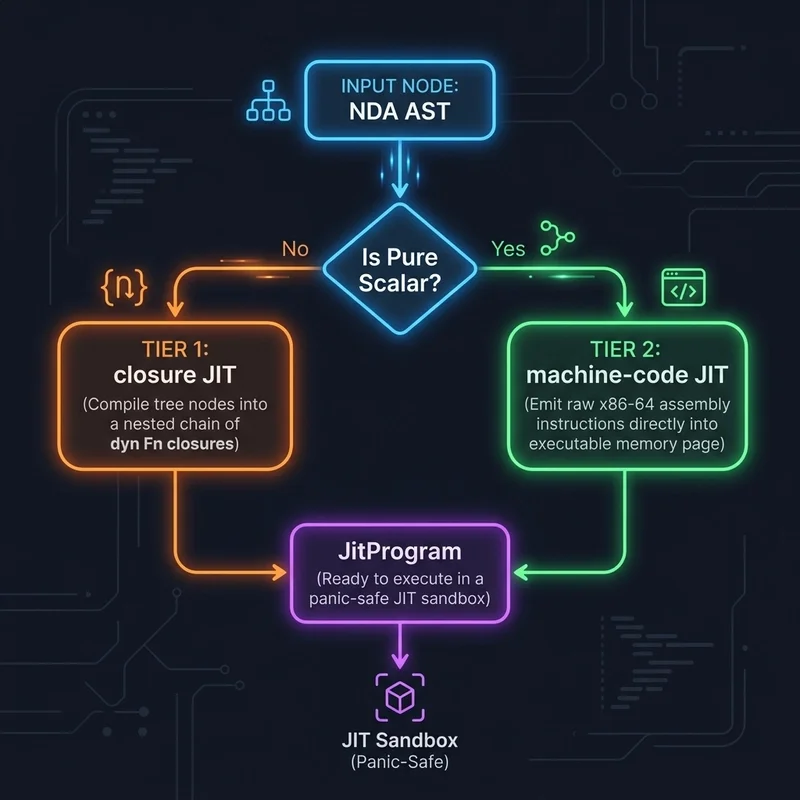
The author is developing a new bare-metal operating system called V.E.L.O.C.I.T.Y.-OS, designed to run within the CPU's L3 cache. As part of this project, they encountered performance issues with a standard interpreter for their Neural Document Architecture (NDA) programs due to excessive dispatch overhead. To address this, a Just-In-Time (JIT) compiler was implemented to translate the Abstract Syntax Tree (AST) into native machine code.This JIT compiler, termed Tier-1 Closure-Based JIT, generates nested Rust closures instead of direct machine instructions. This approach resolves opcode matches, scope checks, and control-flow branches at compile-time, allowing runtime execution to simply traverse a pre-compiled chain of function pointers. Variable lookups are optimized from hash map queries to direct memory offsets by pre-allocating slots and embedding them within the closures.A significant challenge was managing Rust's borrow checker, particularly when closures needed to access external data structures like a Merkle database. Initially, this required expensive reference counting via Arc, but the issue was resolved using Higher-Ranked Trait Bounds (HRTBs) to allow closures to accept states of any lifetime. The JIT engine was further enclosed in a custom sandbox for safe compilation and execution.This closure-based JIT compilation bypasses serialization bottlenecks, allowing for faster processing of model outputs. However, the author notes that further optimizations are needed for heap allocations and integer operations. The next installment will detail optimizations for JIT math, including division-free loops.