ZeroHedge News
Follow
Welcome To Trillionistan; Don't Get Comfortable...
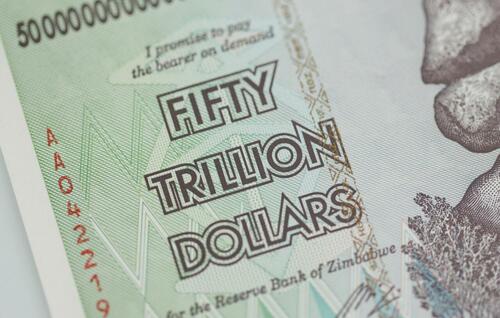
The notion of trillions, once confined to the theoretical realms of the cosmos and submicroscopic particles, has become commonplace in economic and financial life. Today, numerous American companies boast trillion-dollar market capitalizations, with Apple nearing $5 trillion, and BlackRock managing over $15 trillion in assets. This shift from "Billionistan" to "Trillionistan" began with governments, as trillion-dollar economic figures first appeared during 20th-century hyperinflations and the US national debt crossed $1 trillion in 1981.This upward drift in nominal magnitudes is partly due to inflation, as a dollar simply buys less than it once did, making nominal records easier to achieve than real value-driven ones. However, Trillionistan isn't solely explained by inflation; the economy has also genuinely grown, becoming larger, richer, and more technologically sophisticated and global. Companies now serve billions of customers, software scales affordably, and intellectual property generates substantial worldwide returns.It is crucial not to confuse abstract money prices with the actual goods, services, and productive capacities they represent; wealth is created through valuable arrangements of scarce resources, not merely by adding zeros to balance sheets or expanding the money supply. A trillion-dollar company's market capitalization is a continuously revised estimate of future earning power, reflecting millions of judgments about technology, competition, and demand.While entrepreneurial ventures inherently involve speculation, the key concern is whether monetary policy, particularly easy credit and suppressed interest rates, systematically distorts entrepreneurial judgment and promotes malinvestment. Monetary distortion and genuine innovation often coexist, as seen with railroads in "Millionistan" and the internet after the dot-com bubble.Our perception has been rewired by "Trillionistan," leading to complacency towards inflation, debt, and public liabilities, as large numbers anesthetize scrutiny. Not all trillions are equal; entrepreneurial discovery differs from monetary expansion, leverage, or political can-kicking, though most modern trillions blend these elements.The crucial question is not if more entities will cross the trillion-dollar threshold, but what kind of trillion it will be: representing genuine wealth creation, capitalization of future possibilities, inflation by monetary expansion, or an unstable mixture. The zeros only hint at the scale, not the full story, as the foundations for "Quadrillionistan" are already being laid.